Reflections from cities much prettier than Phoenix
12/6/23 to 12/14/23 – Vienna, Austria – Bratislava, Slovakia – Budapest, Hungary
Crew – My inner demons and a lot of Maisie Williams music
Working in the corporate world is a strange business. I mean we could talk about how my job is not the most average of jobs, the fact that I literally crawl through sewers in Phoenix, Arizona. But no one really relates to that. My parents do their best to nod and smile when I explain the stories whereas my friends’ reactions range from interest to horror.
What people do relate to is the strange system of PTO, sick, and holiday days that the corporate world has set up. How little of it accumulates, how it gets cashed out, how much can be accrued, and when it can be used. For example, I learned about a month ago that my “flexible holiday” days don’t carry over into the new year. So I had a month before I faced a “use it or lose it” scenario. This is not ideal because I would like to take the vacation, and I have no interest in spending it in Phoenix sitting in my bed.
I also hadn’t traveled to a new country since 2019. Which is the longest jump for me since 2010 which was the first time I ever travelled internationally. I’m only 23 these numbers don’t seem like much to someone who’s in their 40s but to me, it’s an eternity.
(Random note but I learned last year that I spell “travelling” the British way. No idea why I learned this. But I made the website title this so 18-year-old me sealed my fate on this. I’m still not spelling its colour, however.)
So, it was time to do a new trip. I didn’t have enough time to find anyone as it was so last minute, but I gave it my best shot, pulled up my Excel spreadsheet with the list of places I wanted to visit, and started checking flight prices during Hanukkah. Because I need to use these days during a holiday.
And coming up for $600 round-trip was a flight to Vienna Austria. After checking that I could book a hotel, decided to add on Budapest to rope Hungary into this. I got a chuckle out of it also when the price dropped by another $20 for having my return flight from Budapest, even though I was now flying out of two airports and the new airport was farther from my home destination. What can we say, folks, airline economies are wild.
(I’m not kidding. The ways airlines make money are absurd. Very interesting read if you ever have time and there are plenty of videos about it too. Second only to how the hell airports function on a daily basis.)
But I landed in Vienna. I checked into the hotel. It’s 10 pm at this point so I just go to bed at get up the next day. I missed my connection at Heathrow but there was another flight leaving for Vienna three hours later. Perk of Heathrow.
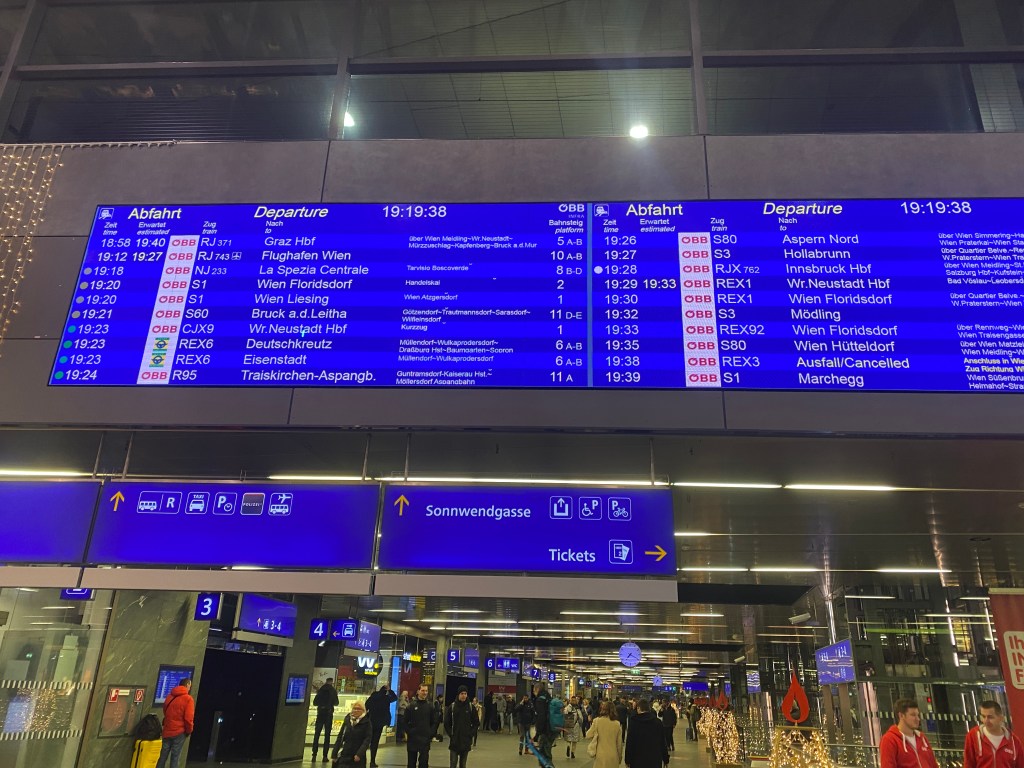
First things first, Vienna is a very nicely designed city. I mean living in Phoenix it’s a low bar that passes for decent public transportation but there’s a train line from the town I was staying into the main rail hub of Vienna and from there this central station was the bus, subway, and train hub. It also had a ton of food options at the lovely train station. While “Asia Gourmet” was a little suspicious of its quality it’s about as good as the cheap Thai food that I ate at Michigan non-stop. And I hate to say it, but Phoenix hasn’t exactly figured out Asian food yet either. I also really proved my vast travel experience and cultural knowledge by immediately getting on the bus and going in the wrong direction.
From the train station, it was easy enough to catch a train to the “Imperial Quarter” which was built at the center of the city. I also really proved my vast travel experience and cultural knowledge by immediately getting on the bus going the wrong direction instead of going towards the Imperial Quarter. Which if the name “Imperial Quarter” didn’t give it away, is one imposing site. Buildings that would be considered showpieces of other cities are a dime a dozen and the parliament buildings of the Austrian-Hungarian empire of old have simply been repurposed into the modern-day ones. There is a certain beauty to them.
(Not in like an acquired taste or requires a special appreciation for the arts. These buildings are absurdly beautiful from a distance and up close)
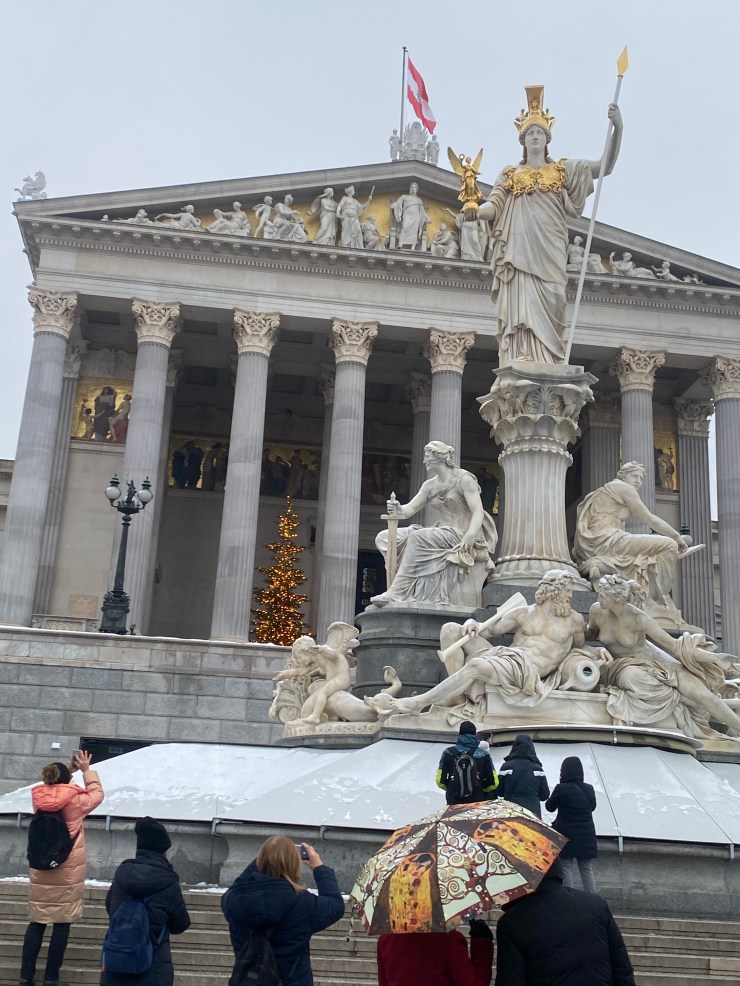
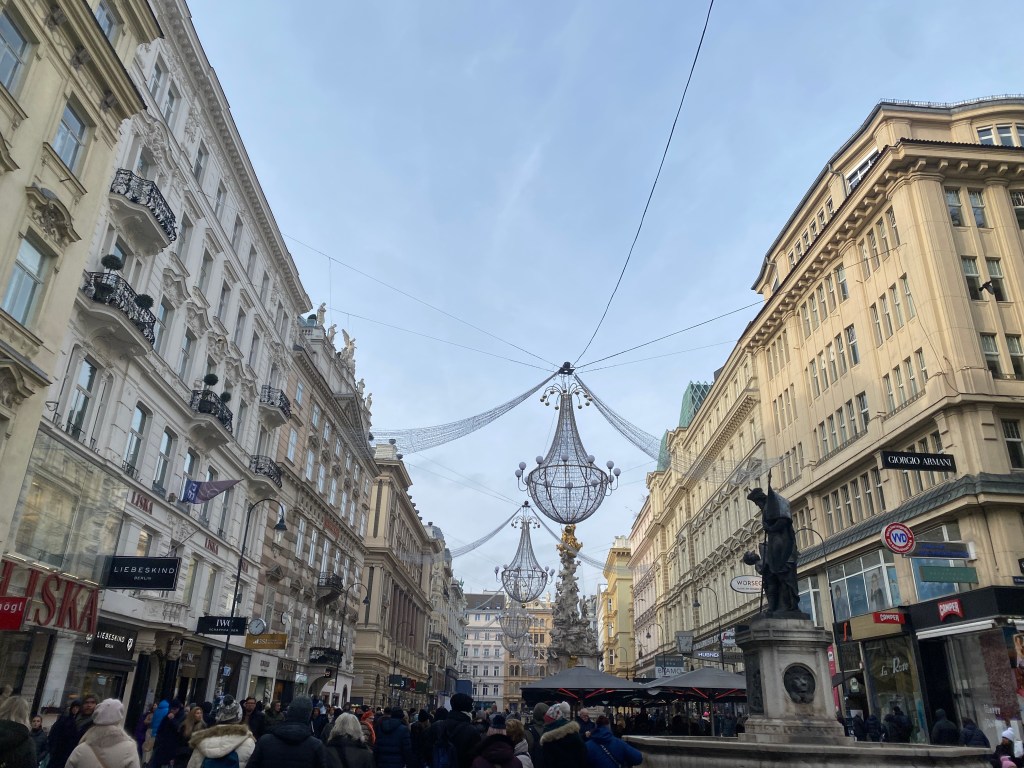
Unironically these are average buildings in the Imperial Quarter
It was also Christmas season! For many of the European cities especially Vienna, markets and trees are set up all over the city. San Francisco had something similar too when I was growing up but nowhere near as widespread as the ones you could find in the cities here. Chicago of all places came the closest to replicating this. But they put their Christmas village up against the White Sox stadium. Vienna put theirs up against the Hapsburg Imperial Palace. There were also these same Christmas villages in Budapest and Bratislava. In Budapest, they sell mulled wine on the side of the street by the cup for €3 which is surprisingly good. Hot wine is very much a unique taste, but I thought it was lovely. And when it’s 9 pm and you can’t realistically justify espresso on vacation it served its purpose well.
On the topic of the Hapsburgs, their palace is still around as I’m nothing, but I absolutely adore the use they found for it. In some countries such as France, they kept the royal palace around as a museum to show off how the revolution happened, in others they destroyed the Netherlands. Or in the UK it’s still in use by the monarchy.
But the Austrians? They just turned the Hapsburg banquet hall into a café that serves $3 espressos. They didn’t even care enough to make it fancy and charge $8 a coffee. But hey the ambiance is great.
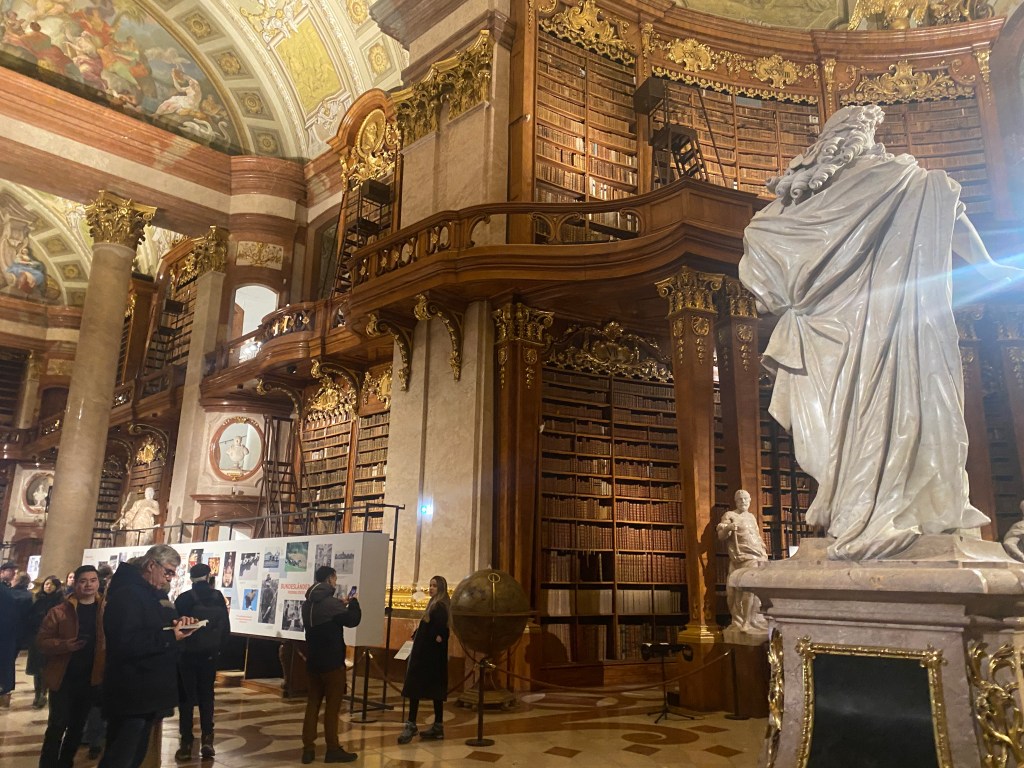
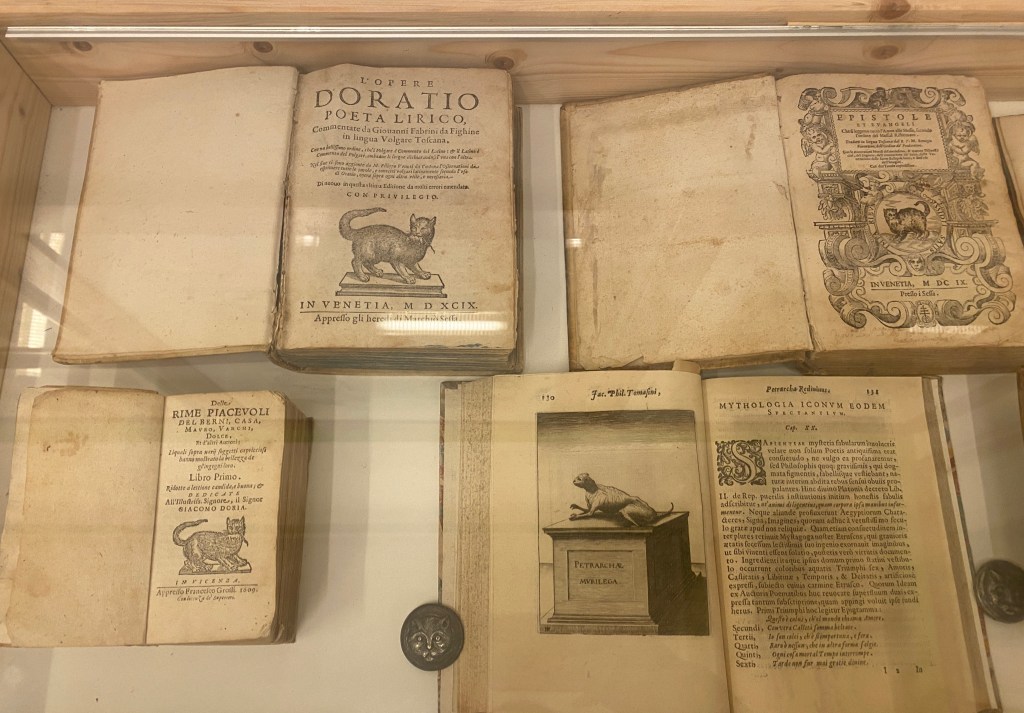
They also had in the palace the book library of the Hapsburgs which dates to the Middle Ages. Not even the high Middle Ages either, but there are books and texts from Charlemagne’s (800 AD) reign preserved there. The entire palace serves multiple purposes today. The prime minister lives in part of the building, part of the national archives is in another. Plus, the two attractions I mentioned earlier.
Even a city as cosmopolitan as Vienna comes with some culture shock side effects. Its cosmopolitan nature more or less causes this first one. So, Austria’s official language is German, and it is flanked by Slovakia, Croatia, Switzerland, Germany, Hungary, and Poland. The official languages of these countries are the following: German, French, Swiss, Croatian, Hungarian, Polish, and Slavic. And that’s just official. So that’d be like saying no one in the US speaks Spanish, Navajo, or Arabic. And of course, everyone learns English in school. The results are that nearly everyone speaks 3 languages. Still, following? Great.
I on the other hand look vaguely Eastern European but could pass for a variety of things. So when I walk up to a coffee counter, ticket desk, or receptionist: The person does their best to try and figure out what language I speak. They start with German, which fails, and then they switch to any of the ones I mentioned earlier until we reach English. For what it’s worth I’m incredibly impressed by the fact that damn near the entire city can power cycle between three languages, but it leads to some entertaining situations. And I’m still not sure I should be flattered or insulted one lady thought I was French.
The other side note I was surprised by was how few American tourists there were in the cities I visited. There were plenty of tourists in the most touristy locations don’t get me wrong but almost none of them were speaking English. Almost all seemed like central European visitors with a few Asian languages scattered through the mix. Which I suppose justifies why people tried English first.
In my time in Vienna, I made my way over to a few other things. Mainly their concerts and Mozart’s old apartment. They sell opera and classical music concerts for €15 with seats even included in the various churches of Vienna. I wouldn’t exactly call them good seats but they’re a damn good deal for what you pay. There are also concerts nearly every night even in winter which is the tourism off-season, meaning that acquiring tickets was an easy process.
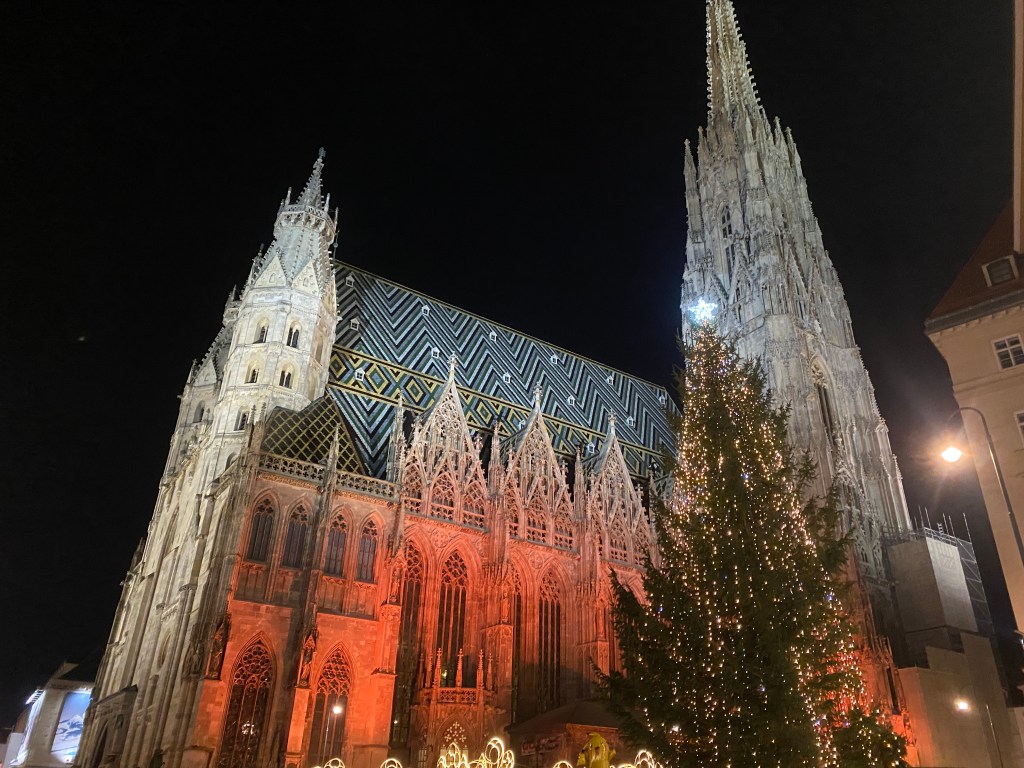
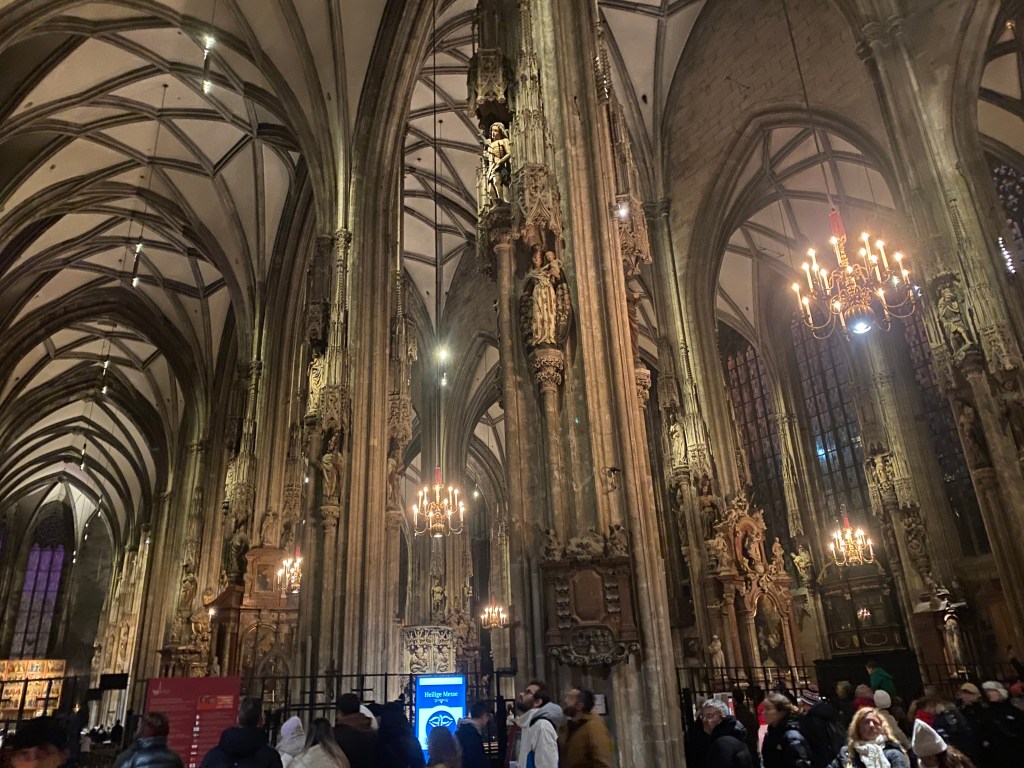
The church the concert was in. Both outside and inside
Probably the largest downside of booking this trip so late however was that I needed to find a hotel that was cheap enough and I didn’t want to stay in a hostel. You can definitely argue is I causing my own problems by not planning ahead and by not wanting to stay in a hostel.
But! I found a lovely place in a town 15 minutes by train out of the city. The owner was incredibly sweet, it was basically an Airbnb except without the middleman and nonsense fees (yay!), and she gave me recommendations on where to go. It was much quieter than Vienna itself, and at least showed me how quickly Austria could go from a chaotic major city to a quiet countryside. Very similar to Detroit versus the rest of Michigan.
One of the other sites I saw in Vienna was Café Central. A nice café and restaurant to be sure, made famous by its long history and the amount of influential (and often terrible) people that have eaten there. It opened in 1876 and quickly became one of the leading places for intellectuals of Europe to meet. Examples were Sigmund Freud (who was so wrong about psychology that the field was created to prove him wrong), Theodor Herzl (father of modern Zionism), and Peter Altenberg (who led modernism in Vienna). Along with of course a variety of… less lovely individuals such as Stalin, Tito, and even Hitler. There’s a (maybe true) story that one of the Austrian counts questioned if a revolution would happen soon in a European monarchy, to which another patron of the establishment laughed saying “And who will lead this revolution? Perhaps Mr. Bronstein (Leon Trotsky) sitting over there?”
Food was also good there if anyone was curious.
With a day left on my stay in Vienna, I also decided to make a quick trip over to Slovakia for half the day. From the train station where I would arrive in Vienna from town, there was a 1 hour €18 roundtrip train ticket to Bratislava, the capital of Slovakia. Why not?
Bratislava is known for being a much calmer version of Vienna, and I’d agree with that assessment. The city was much more relaxed, the attractions less grand, and many fewer visitors. Although the tourist quarter had quite a few walking around. The streets are the same cobblestone and the buildings are the same weathered old you find in the parts of Europe that weren’t leveled during the 20th century.
The soviet influence was also much more prominent in the city. Any building that didn’t have the old-timey look was a concrete box that seemed mass-produced.
(Which also seems like the average house in Phoenix. Oops).
I stopped by most of the important churches and monuments that were standing. Plus I got complimented by the lady at the Christmas market for being a good kid and buying gifts for my parents!
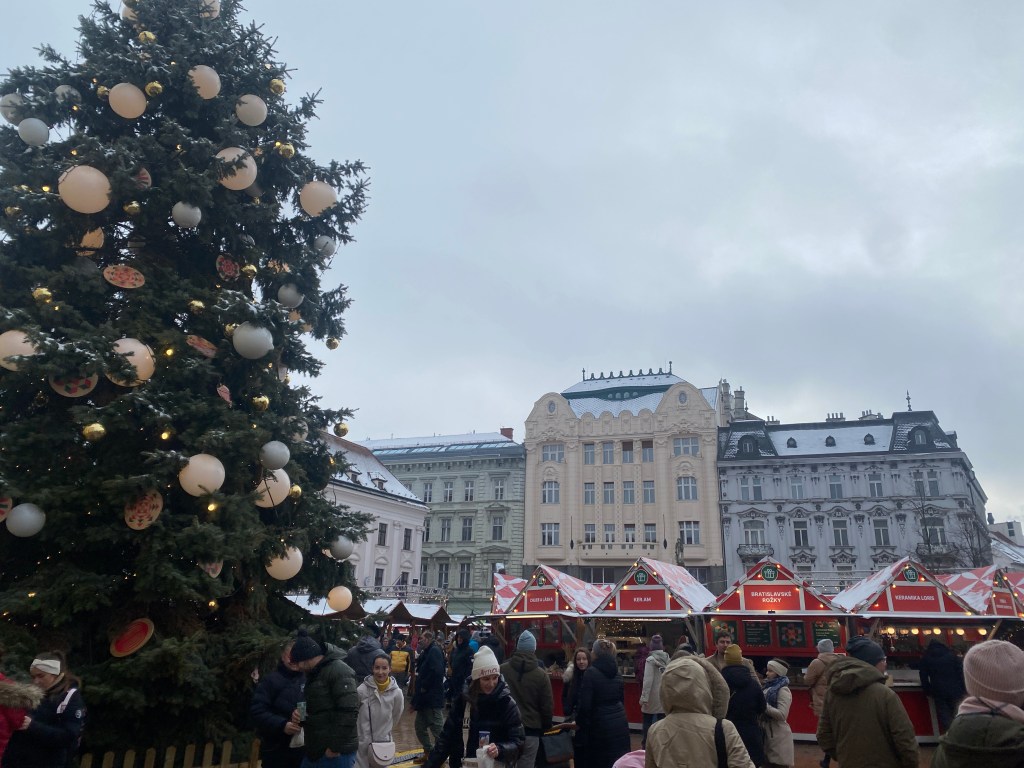
With three days left in my trip, however, it was time to move on. So I packed up onto a train and headed for Budapest. Initially, Budapest looks very similar, and I can see the resemblance as part of the whole “Austria-Hungarian” empire thing but there are some noticeable differences.
For one, Austria has a dramatically more multi-use design than the United States, but Budapest took multi-use zoning to the next level. Everything was piled on top of each other. Apartment complexes, nightclubs, restaurants, and grocery stores were scattered throughout the city. While there were still parts of the city that were more specialized in one than others, the entire city could operate on its own. I stayed in the Jewish quarter which was more known for attractions and night-life events. Basically, the stuff tourism lives and breathes on.
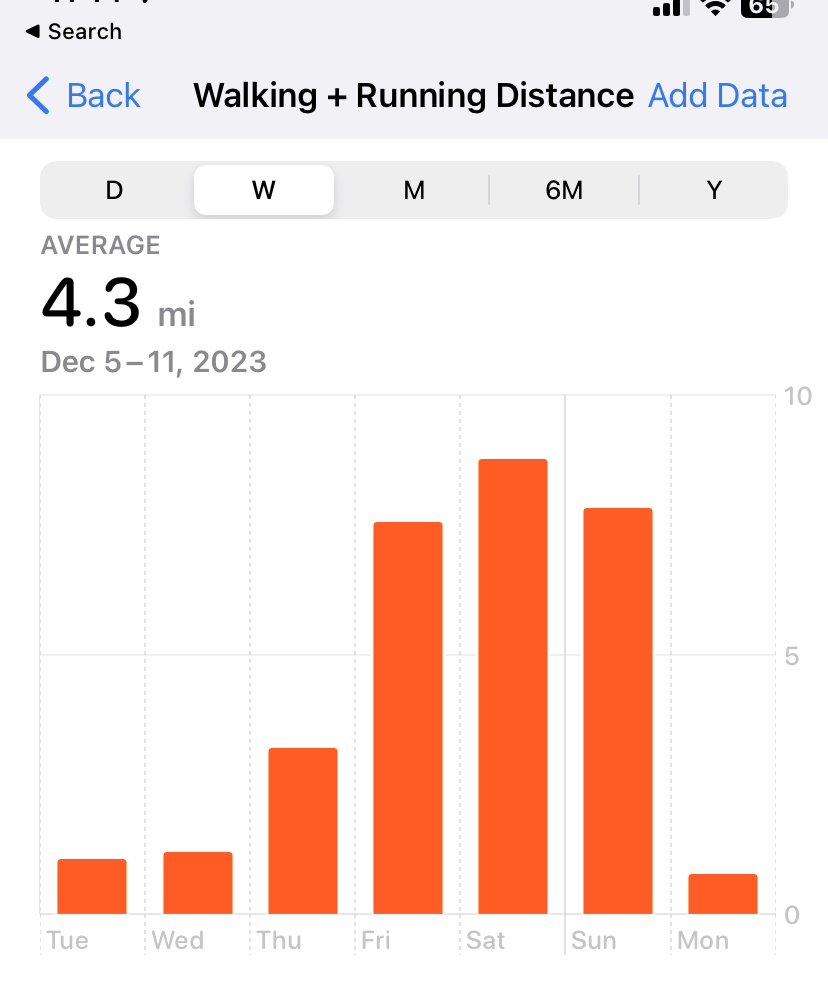
Budapest and Bratislava are also definitely cheaper than Vienna, which is still cheaper than the US. But I was routinely surprised by the prices of things in Budapest. I could buy half a pizza for $3 from the place half a block from my hotel. Hungary to my surprise unlike the other two cities I visited does not use the Euro, even though it is part of the European Union. They still use the Forint, named after Florence, where the coins were originally printed. The conversion is 354 Forint: 1 USD which is not a great conversion to have to run at every single store in the country, but I can’t complain. A month ago, I took a nine-hour exam in the US which had the most God-awful unit conversions you could think of.
(43,560 square feet being equal to 1 acre, while 2.47 acres are equal to 1 global acre are my personal favorites)
One of my friends from High School, Lorand, is also from Budapest. Therefore I asked him for all his recommendations and thoughts and I’m so very thankful that he sent me one hell of a text with all the things and food to see. On the list were tourist attractions, general places to see, and some fantastic food recommendations. His focaccia sandwich in particular was astounding, And I’m normally not much of a foodie.
Moving onto the tourist attractions of Budapest, I made my way across the Danube River to see the old palace and National History Museum, both kept next to each other. Budapest was first settled a few hundred years BC then had a steady stream of different nations govern it. Which for Eastern Europe is very common. Even in nations that we think about as long-lasting as Russia was Muscovy until 1721. And of course, you have examples like Croatia’s independence in 2004. Budapest also made it very clear in all their museums that they have no particular love for foreign nations that conquer them. Large parts of the palace were lost in the 2nd world War and then the Russians occupied it after they remodeled it to be closer to what a good Soviet building should look like.
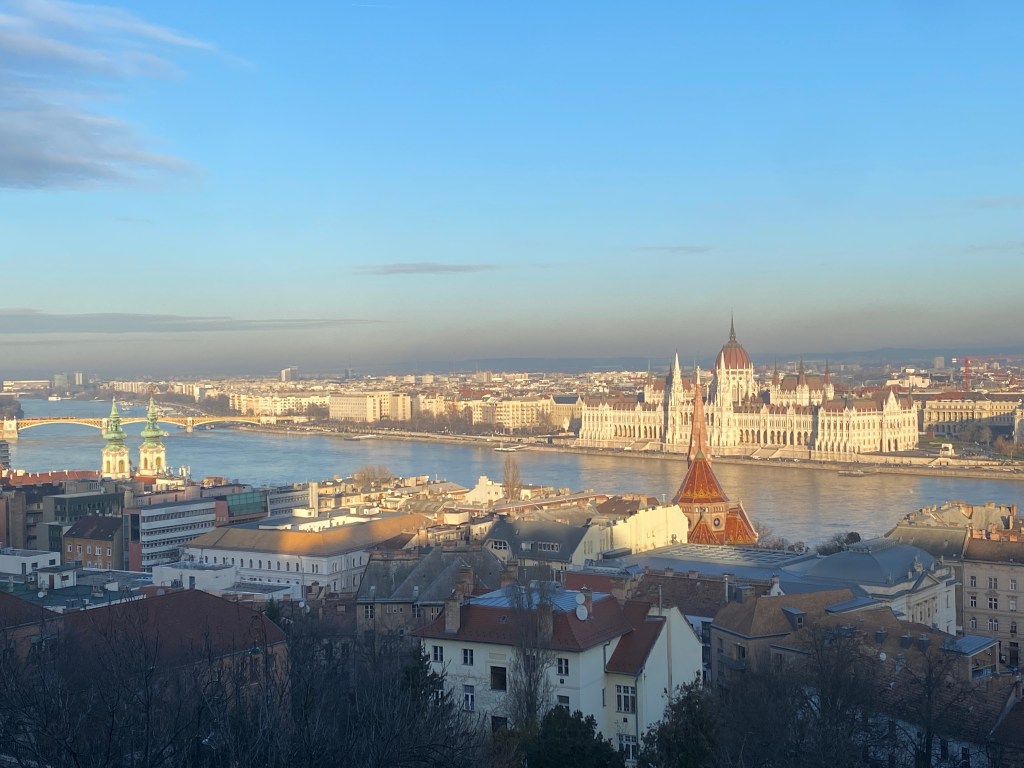
Next to this is the Fisherman’s Bastion, which is a whole fortress. I had to look up why it got the name “Fisherman” in front of it. Turns out it’s either because the Fisherman’s guild was entrusted to it, or because the nearby town to the bastion was called Fishtown. Also, in wars the fishing guild was reported to have defended Budapest using the bastion, which I much prefer as a story so I’m going to hope that the former story is the reason behind the name. You also get a fantastic view of the Danube
Budapest also has what are called “Ruin Bars” which are popular tourist attractions. It’s like a dive bar…. But fun trashy instead of just trashy. (Before someone picks up a pitchfork, I love dive bars. After all, they’re cheap). But instead of drinking alone there, I met up with Charlotte from my HS graduating class, who just messaged me that they were living in Budapest when I put it on my story.
It was great getting to see her again, as I hadn’t seen her literally since the day of High School graduation, which is now four and a half years ago. Swapped updates on what’s happened, how she ended up in Budapest, and how everyone from our hometown is doing.
Sidenote on that: It’s very fun but never-ending trying to keep track of just my friends from high school and college, not even bringing in my acquaintances and just other people I knew. To a large degree, it’s fun and at least gives me something to talk about when I see folks from old. I’m not sure being known as an incurable gossip is a particularly positive reputation to have but at least I know I would’ve made a good court gossip for the Hapsburgs three centuries ago. I even keep a map of the United States on my living room wall with all my friend’s names pinned to where they are in the country. I somewhat want to expand it to the world.
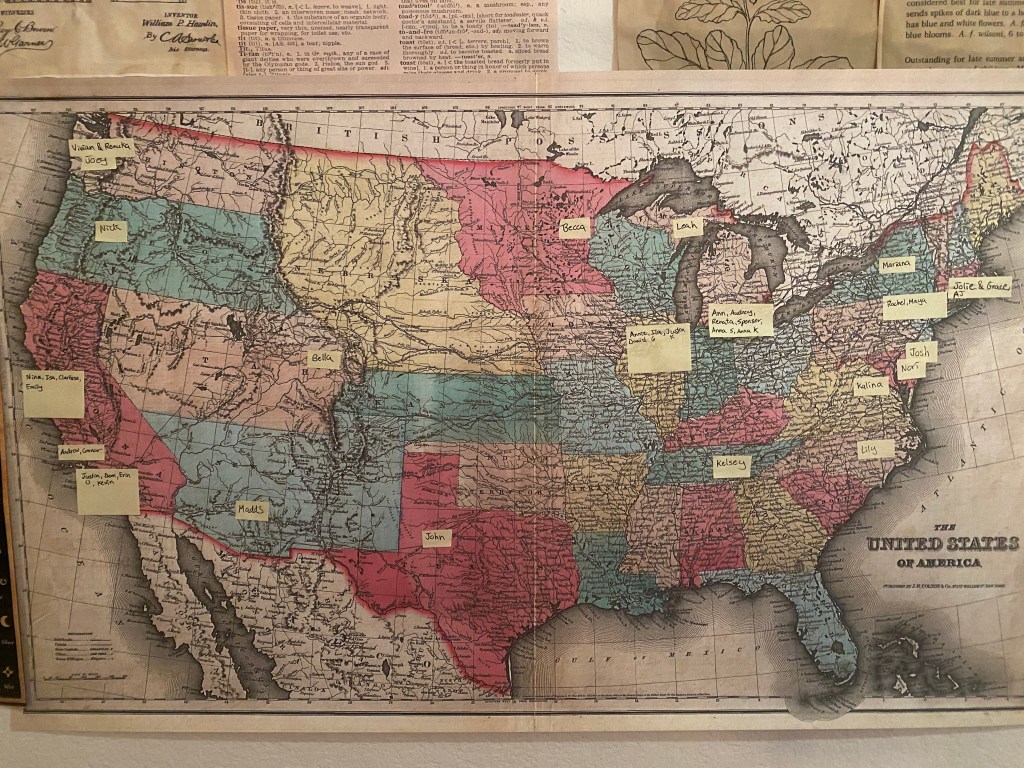
The last major spot I spent time at in Budapest was the old terror building. Unlike the San Francisco one is not a tourist trap but the literal building of both the Nazi and Soviet secret police while Hungary was under the control of both. After the independence of Hungary in 1989, the building was turned into a museum. With all sorts of video interviews and artifacts from these two governments. At the end of the museum was a hallway with photos, names, and positions of every single important member of the secret police in these two regimes. One consistent trend in central Europe is they do not tend to shy away from being blunt about the 20th century.
The trip ended with an all-nighter into 13 hours of flights to land in Phoenix at 4 pm with work the next day. Felt fine that day at work. Between the number of places my parents dragged me travelling and engineering school: An immunity to jet lag was a lovely, unexpected benefit. That or the sleep schedule part of my body needs a better union. Even better when I was heading out of Budapest the girls at the bakery Lorand recommended to me gave me a bunch of free pastries since they were closing. Maybe I had a cute American accent, or maybe I just looked tired enough that they felt bad. Plus they would’ve had to throw them away anyhow. I wasn’t about to complain though
Funny enough after this was all booked my boss informed me that in no way do I have to use “Flex holiday” days during a holiday or even around a holiday. More you know. And here’s a photo I took of a goat eating a Christmas tree.

Warmly,
Sam
 Dead Man Travelling