7/27/19 to 8/10/19 – Buca Bay/Savusavu, Fiji
Crew – Engineers Without Borders! Pratik Batter, Kristine Tolentino, Brad Harkin, Pritha Hait
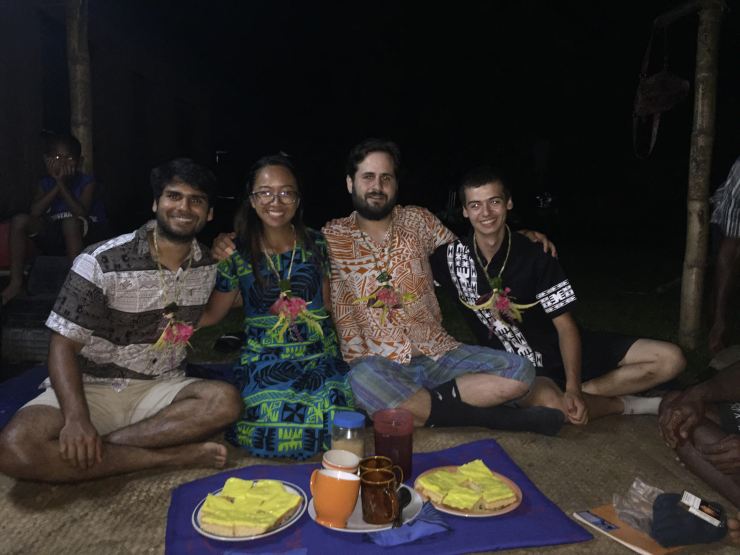
Picture Above (Left to Right): Brad, Kristine, me, Pritha.
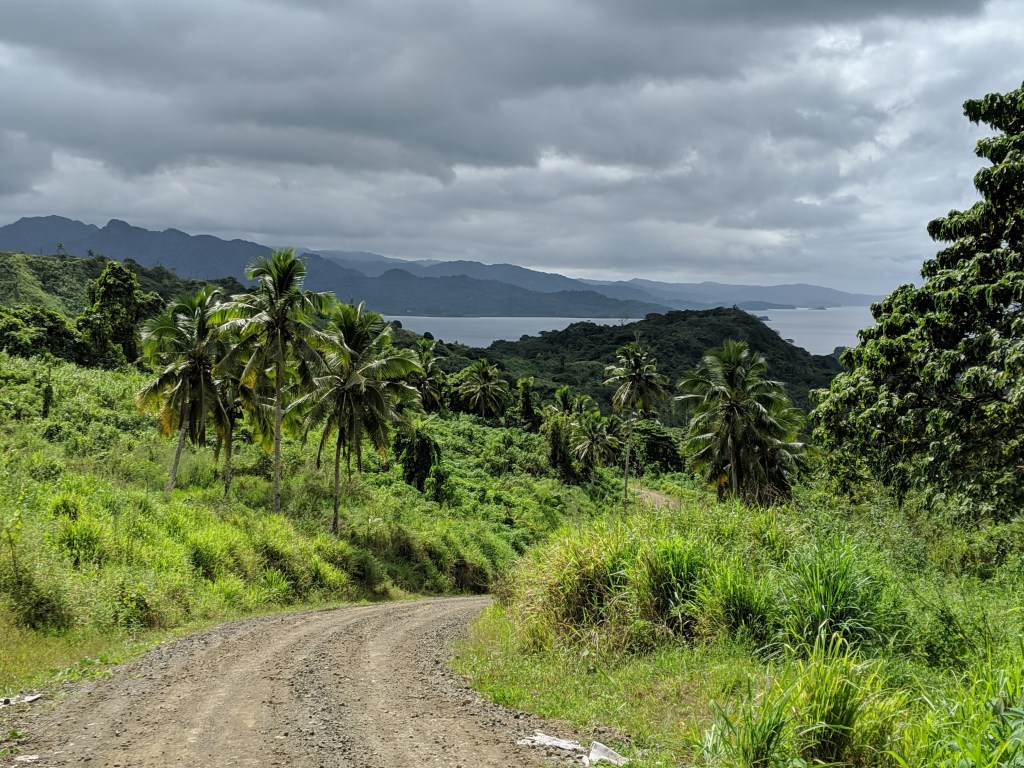
Bad news: Driving through pot-hole ridden and washed out dirt roads in a stick shift pickup was bumpy.
Good news: We had Brad’s fire Portugal the Man on the aux cable.
Bad news: The car handled worse than usual due to 10 Fijian men in the back with shovels
Good news: They collected sand at an unholy pace.at the beach which the owner had let Brad and Kristine use
Bad news: We needed 15,000 lbs by our conservative estimates.
Good news: We didn’t get the car stuck in the ocean when we backed up on the actual beach during low tide.
Bad news: The truck was dangerously overweight with 2,000 lbs of sand and 10 dudes in the back
Good news: We made it back in one piece.
Bad news: We needed at least half a dozen more trips
Oh, that was also a casual morning in Fiji. And I had 10 hours of that level of insanity every day. For two weeks.
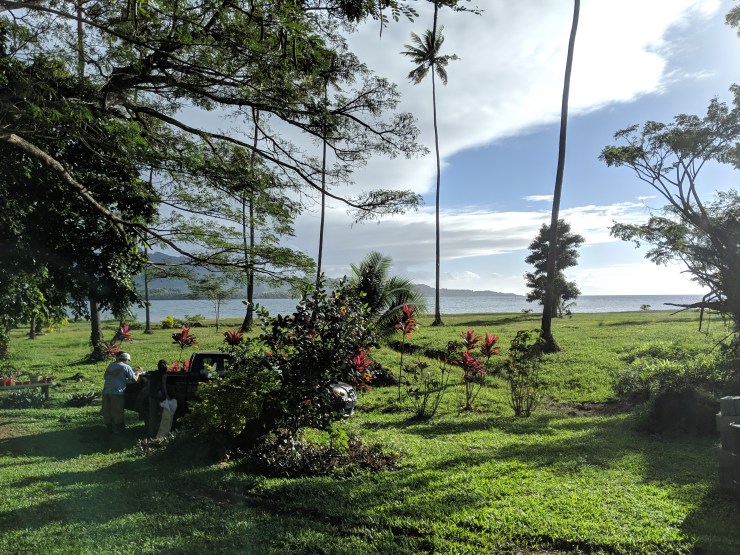
Ok, in all honesty, I would not vacation in Fiji after this. Not because the people aren’t amazing (quite to the contrary) but because this country was constantly raining in the “dry” season and overcast. Not to mention that the resorts which offer hot showers, wifi and electricity can put you back a solid 20k a week. And a non-profit does not have that kind of money. Luckily even though I traveled cheaply we had a generator we bought fuel for and mosquito nets.
But where are my manners? I don’t particularly like Victorian England and constant manners, but I should explain how I ended up in Fiji with professional engineers. In this case, going back multiple months. There’s a lot of backstory to explain Engineers Without Borders: a non-profit that has hundreds of project teams around the world but mainly based out of the United States. The organization uses engineers and others in chapters to help solve problems globally. I’m currently part of the San Francisco Professional Chapter Fiji Team, SFP-Fiji for short. The chapter has eight teams: Fiji, Ethiopia, Haiti, Honduras, Kenya, two Nicaragua teams, a domestic team, and an R&D team.
Looking for summer plans and new groups to join the second-semester senior year I decided to show up to an SF general chapter meeting in the city and see if I could talk to anyone. Besides scoring a sweet amount of free food I listened to two far too technical presentations on cleaning up a superfund site (nuclear waste) and finding cheap ways to smash rocks for wells in Kenya (More interesting than you think). At that point, the head of the chapter told everyone to make some new friends and everyone started walking around. I honestly expected to have to put myself out there, but I was very quickly singled out by the head of the Chapter because there were 150 adults over the age of 22 in work clothes and I stood out. She was unexpectedly understanding of my desire to get involved with professionals and told me to ask around. I asked five teams, four of which had no use for me. But I met Dominic Molinari, a member of SF Fiji and it would turn a great person from start to finish. He invited me to the next Fiji meeting and a week later I was involved.
The Fiji team consists of around 30 members that met for 90 minutes once every other week in SF and planned for the upcoming trip to Fiji. The project leaders at the time were Zach and Kristine, by the halfway mark just Kristine. Moreover, we divided into four teams: Biosand filters, Buca Pipeline, Sanitation and Education (my team with Pratik as team leader). Of those 30 members, 7 of us traveled this summer and those of us who traveled attended a half dozen extra meetings and learned about the other teams. I had experience teaching kids and a complete lack of technical education in engineering so I went on education and somehow ended up cleared to go. Which means that they paid for 85% of my trip and I had to work over $1000 for two weeks that I fundraised. One hell of a deal.
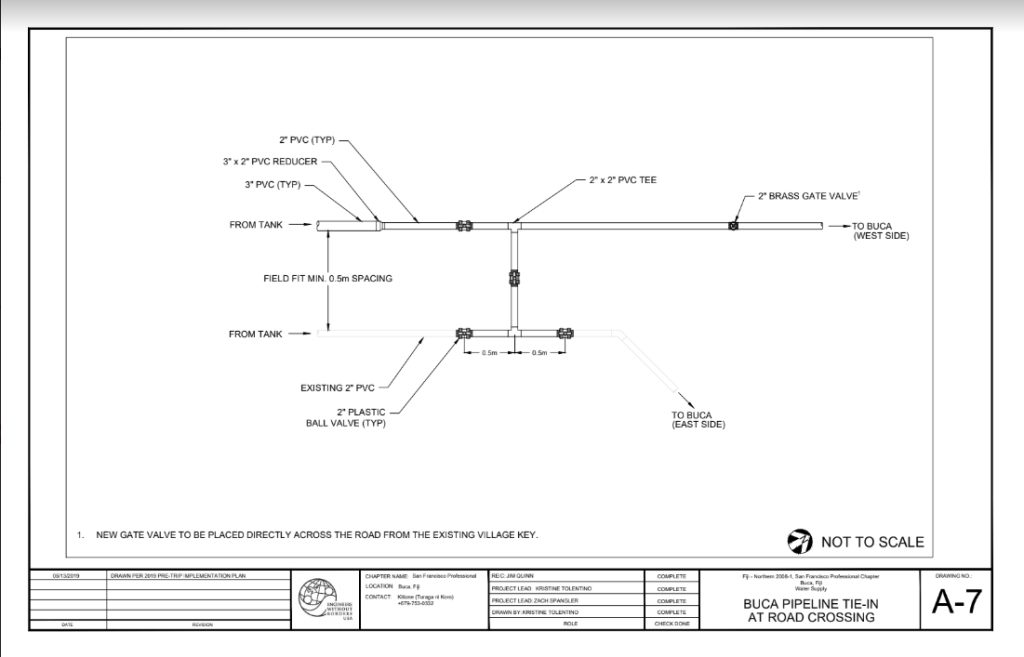
That’s not to mention that I did nothing before I went. Besides the bi-weekly meeting, I had a meeting on the off-week with the education team developing curriculum. I attended either through Skype or in-person 6 travel clinics beforehand and easily dropped 100 hours into the project. But by the end, I was mostly prepared, quite nervous and caught a red-eye from Australia! Our main focus this year was to build a 1 km pipeline from the Buca Storage tank to the actual village and augmenting the current line.
The international airport of Fiji located in Nadi (nan-di) was a modern-day airport complete with decent restaurants, complimentary Fiji water, and air conditioning. After arrival though I needed to take a second flight to Savusavu and a few helpful questions later I headed over to the domestic terminal which had heavy similarities to the half-constructed run-down airport at Syracuse that my mom used to fly into. Much more in character for where I was going.
Even better the plane taking me to Savusavu was an 1131 Otter and a classic prop beater. The airport I landed at was a runway in the jungle with a garage converted into an arrival and departure area complete with an eight-car parking area. Welcome to rural Fiji!
I quickly texted Kristine and twenty minutes later she and Pratik appeared in our rented pickup truck, later. Few quick hugs and they threw my luggage into the back and exclaimed “snorkeling time” and off to the beach! Snorkeling was eh but the experience was fun even though Kristine couldn’t swim. The car was filled with items from errands and we picked up pizza for Mama and Rasalala and headed out to Buca Bay, 90 minutes car drive away. Buca Bay has three main villages that we work with every year: Buca, Tukavasi and Loa. Normally we try to divide evenly but since we were building a massive pipeline for Buca we spent most of our time there.
Kristine was my team leader during the trip and a 23-year master student at Cal in water engineering. Pratik played the part of a Genentech engineer with a master’s in chemical engineering. Brad has the role of a former professional with a Ph.D. in sub-surface hydrology. Finally, Pritha who landed a week in when Pratik left has a masters in electrical engineering and works with literal atoms. So, I totally wasn’t intimidated at all by who I was working with. Even better Kristine’s mom grew up without rice sometimes and Pratik’s dad went to college homeless. These folks are hardcore in general and are hardcore travelers to the max. 6:30 wakeups consistently followed by six hours of trench building. Afterward, we would take a communal lunch break with the village (lunch manda) followed by rest manda for 30 minutes and then back for another three hours. The work was exhausting, and we weren’t even doing the heavy labor.
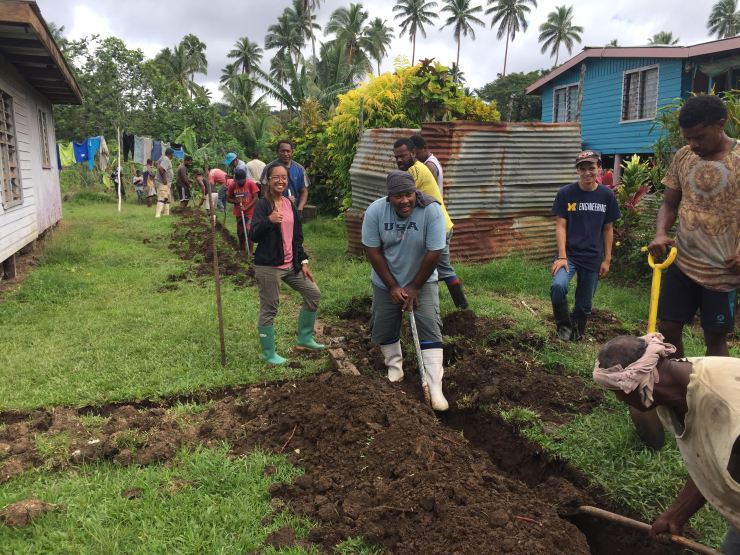
Even worse, we weren’t on schedule.
The Wednesday after I arrived the lunch break was summarized by Pratik with the statement “We are fucked” and for a legitimate reason. Our project was ambitious, to begin with, and we slowly began to realize the sheer amount of work that had to be done. We every section of pipe we had to dig half a meter down, place sand on the bottom, level it, glue a pipe that couldn’t get wet for two hours and then bury the entire thing. For a kilometer. Even worse that was ignoring the endless rain (try flattening a trench you can’t see) and the endless roadblocks. We had ditches to cross, a bridge to traverse and by my best estimates 15,000 pounds of sand. Finally, the boys couldn’t work on Tuesday because they sold coconut to the government on that day. By lunchtime of we had made it 100 meters and were expected to make it another 700 meters in the next two days.
I would call what happened next a miracle but it can better be attributed to some hardcore industrial engineering, a TK and what Kristine dubbed the “Fijian juggernaut”. One of the largest issues was that the entire system was inefficient. There are four clans in the village of Buca and over the first week and a half the clans took turns volunteering on the pipeline. Furthermore, we started at 8:30, half of the boys went to the farm after lunch and everyone else hard stopped at 4 pm. On Wednesday though the TK Kiti showed back up from arguing with the government. A TK plays the role of mayor and representative to the government and can be elected or appointed for a four-year term. While lacking the sacred power of the Ratu, he plays a much more active role in the village. Kiti got things moving with a few decrees. Simultaneously we improved our system of labor that used teams to do important jobs with oversight and made sure the truck was always best used. No more just dig forward randomly. We started planning out during breaks where everyone was most efficient. All this plus a few lucky breaks and the following happening:
A) Kiti made sure every clan was offering every available man every day. At one point after Kristine and I were backfilling and turned around and whereas we started with six another two dozen had shown up behind us.
B) We were in the village every day between 7:30 and 8:00 to get the train moving and we worked until 5:30 some days if the morale lasted.
C) No more coconut selling on Tuesday. We needed the pipeline done.
D) The rain stopped coming down during the day. Not our doing but a lifesaver.
E) Our industrial engineering paid off and the boys worked in a far more efficient pattern able to cover vast amounts of ground.
F) Other villagers started offering support. School buses would load pipes in the back after dropping off kids and unload them to me. Random farmers would transport ten boys at a time to the worksite. All without us asking.
G) Every step we took put us closer to the village simplifying logistics and raising morale.
H) The boys once they got into a pattern pulled off physically amazing feats.
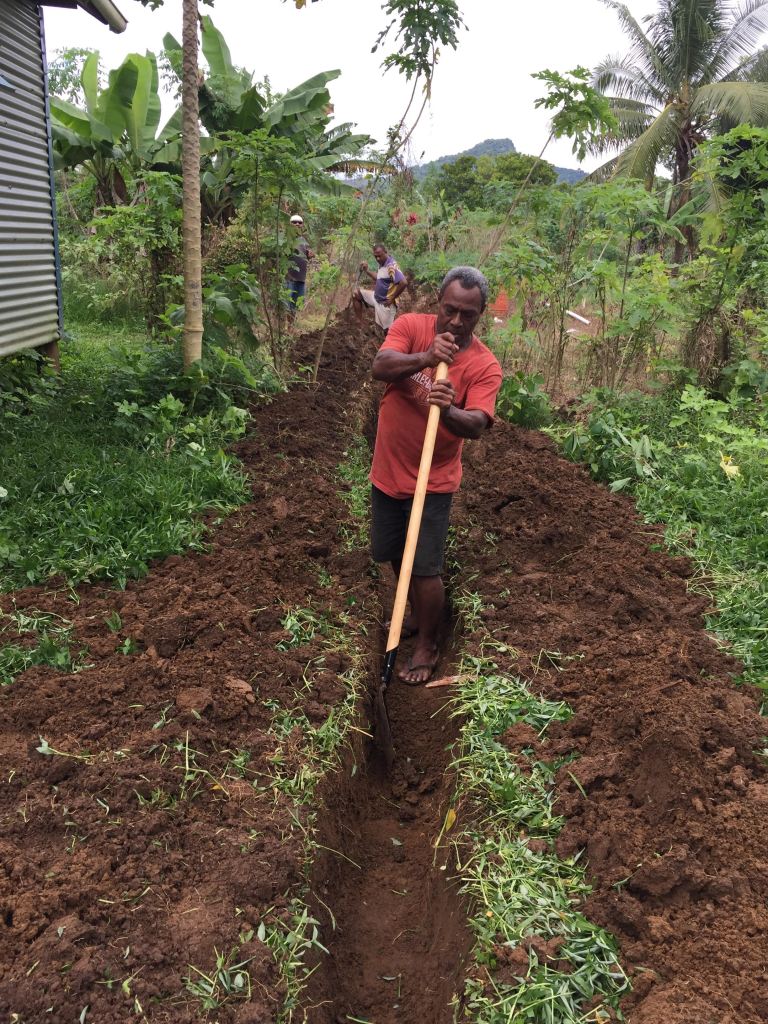
The final point deserves a special note because I must talk about the sheer average fitness of the Fijian farmers. I imagine a few people are rolling their eyes and saying, “yes they’re sustenance farmers without mechanical tools, how could they not be fit?” but you need to understand the degree. Over two weeks I met two Fijian men who were under 6 ft tall. Their lifestyle involved working on their farm for 8 hours a day followed by playing rugby for another 2 hours followed by drinking Kava and socializing for another two. Then repeating that five days a week for fifty years. There was a term we learned: “Fijian men eat devil” and they proved it.
Example: I was surveying where the pipe needed to go through the village and swore in three languages when I realized we had to carve 100 meters through 100 meters of straight untouched jungle. At that point, Petro came up behind me and asked what was wrong. Petro was the former TK (mayor), a homie and jacked so I explained the problem to him and he just gestured for me to stand back and called a friend of his over. He then pulls out dual machetes and systematically obliterates 100 m of Jungle in 20 minutes flat with his friend picking up the sliced parts and clearing them off the trail.
Josh Rogers might currently be traveling Europe on a classic gap year with a trusty road bike which has an aesthetic of aged wine. However, when you need to carry 284 5.8 m PVC pipes between 2 and 4 inches in diameter a bike will not cut it. Instead, we upgraded to a 4-wheel drive stick-shift pickup truck with the aesthetic of moonshine. Even following the classic rural area rules of “Drive in the center of the road to avoid washouts” and “Sam ignore the weird hissing noise while driving” we nearly smashed this thing. It was driving 8 hours a day for high maintenance. We lost the left taillight (Loa found it eventually), the fuses in the cabin blew, the right front axle bent, deflated a tire, deflated the spare, broke the hinge in the back and purposefully sped over bumps. I loved that thing but we might a concentrated effort not to park in front of the rental company in town.
We didn’t only build a pipeline though. The team had several separate components that we worked over the two weeks. Since I managed to make it onto the team because of my experience teaching summer camps (thanks and rest in peace SPCA) I was planning the secondary school educational activities before traveling. So much writing. I must’ve written 40 pages in total of educational materials and feedback on other documents if you include rewrites. But in Fiji, I was one of two teachers working with primary and secondary schools on lessons.
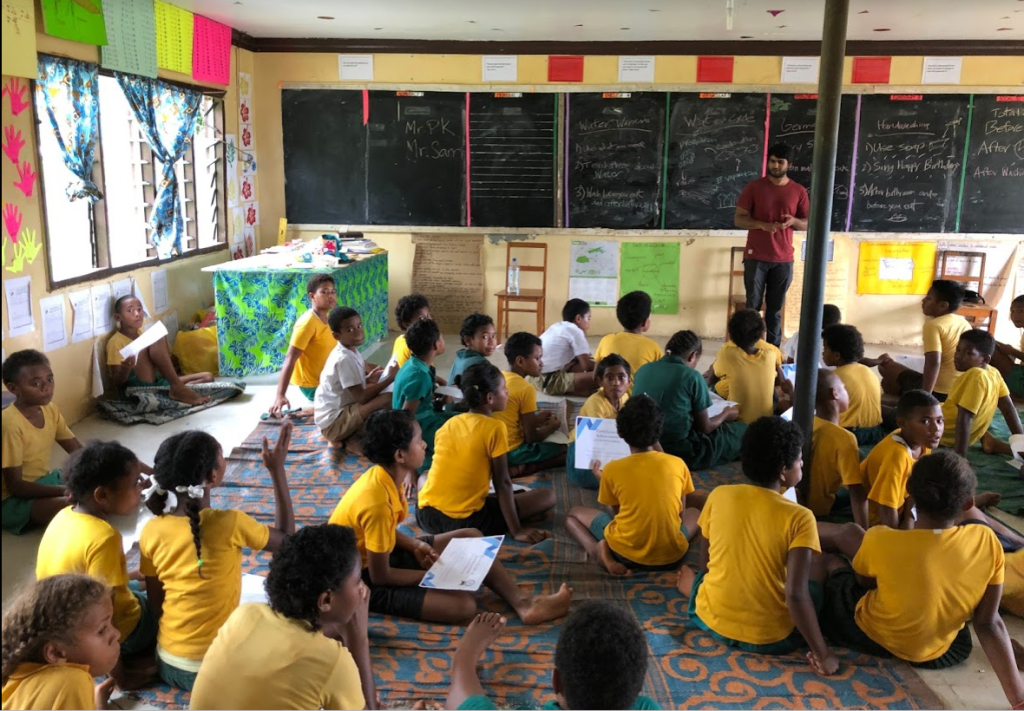
For the secondary school, Pratik and I talked about germ theory, the scientific method and how biosand filters are constructed. The unsettling part was that I was teaching our equivalent of High School juniors and seniors. Teaching someone your own age was confusing but while they have a robust High School system (I saw calculus and world history textbooks) they have no coverage of disease or water quality. We quickly learned group work wasn’t common in High School and the students were confused by the thinking activities but soon got into the idea of them doing the work and us just giving a basic understanding. After sitting through four years of High School I was not about to lecture them. Afterward, we had various teachers, other students and parents ask for their unbiased opinion of us and the response was surprisingly positive. Validation for all that work.
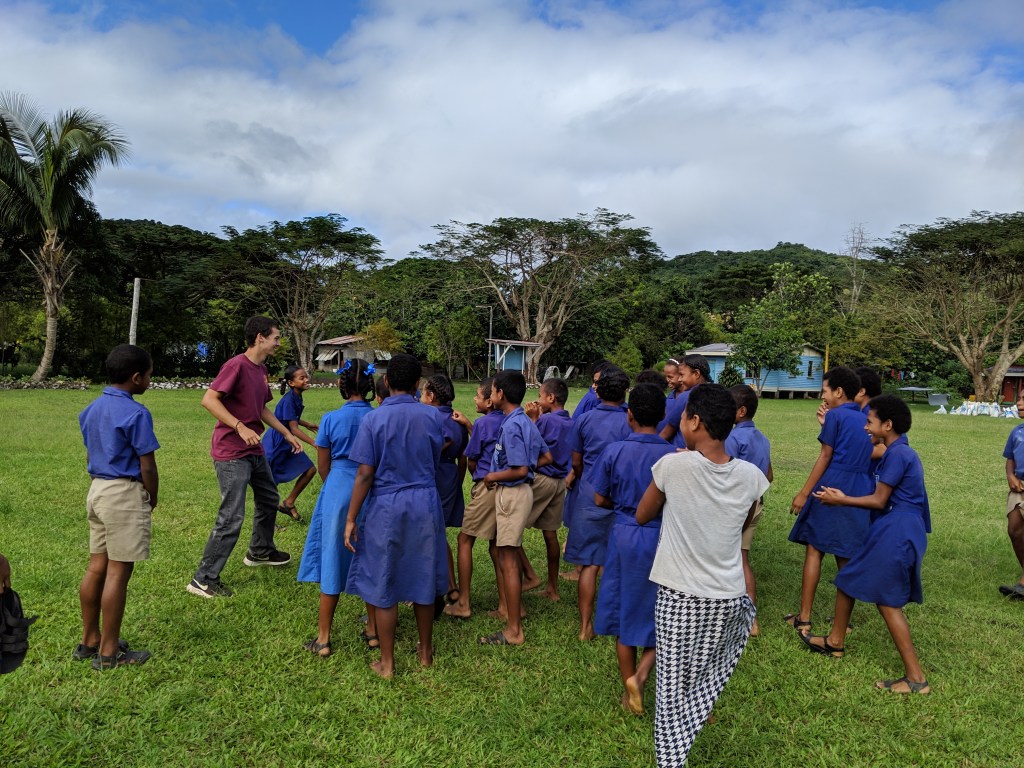
The elementary school kids in comparison were far less intimidating of a task but far more tiring. The first class I did with Pratik we had 45 kids and the second one I did with Pritha I had 35 kids. Both were grades 5-8. We taught lessons on the water cycle, washing your hands, how biosand filters work and understanding how water gets dirty. The kids had incredibly good English and refused (possibly out of pride) for the teacher to translate. Amazingly well behaved compared to American students and really got into the lessons and following along. Plus, I taught them dance moves for the water cycle that they continually found hilarious. The teachers gave us free lunch both times at the end, so if they truly hated us I suppose they would’ve just kicked us out.
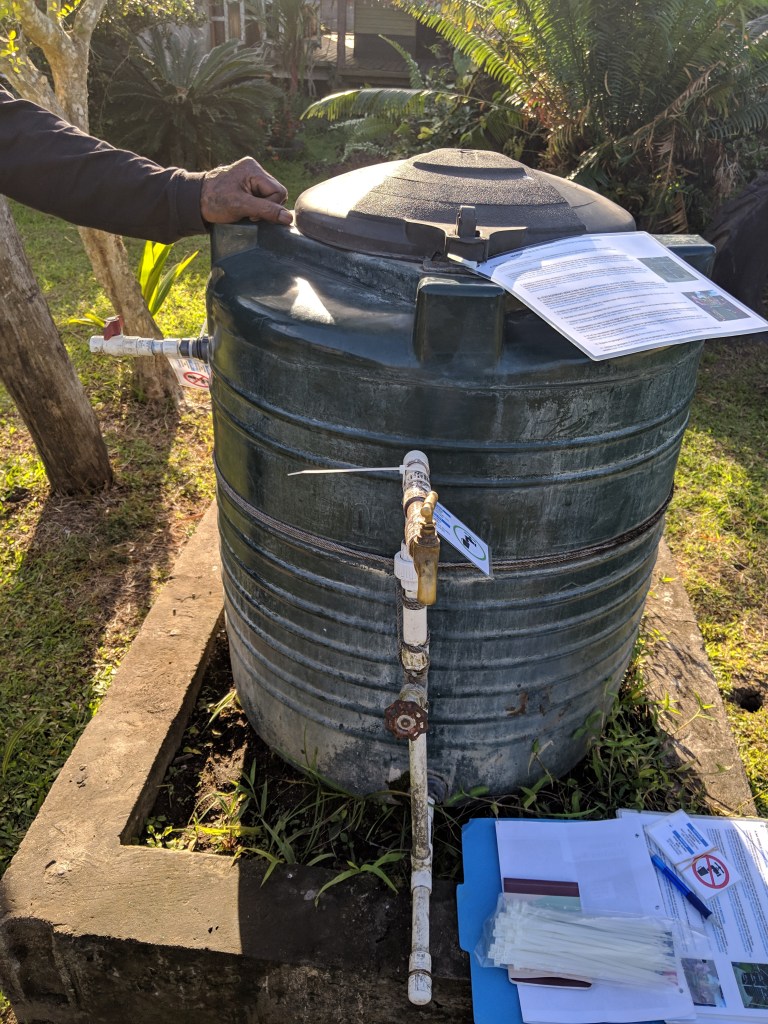
Why spend time teaching kids when there were only four of us on a given day? Because EWB understands why most humanitarian aid projects fail (in reality an overwhelming number) and spends a lot of time figuring out how to prevent that fate. One of the largest counters to projects breaking, being forgotten or not solving their purpose was a lack of education. Hence why we always work alongside the adult villagers and spend hours teaching the children about what we do. We require the villagers to pay between 5-10% on every project we do to make they have care. Having a group of rich people coming and building you something for free and then that thing breaking has absolutely no consequence. Spending $600 and having it break has a huge consequence. The communities being helped have to apply for an engineering chapter and we are required to spend a year analyzing the area and understanding the local community before building anything massive. Finally, we have constant paperwork and memorandums of understanding to make sure the villagers understand the project and testimonies after by a 3rd party. I will absolutely admit that the system we have doesn’t always work, but EWB does avoid the pitfalls of most projects.
Education materials aside, by Wednesday night of the 2nd week we had by previously described miracle finished the pipeline. Before turning on the pipeline Pritha, Brad and I had spent twenty minutes trying to use napkin math to see how long it would take water to come out and how much. Kristine just regretted her life decisions and asked why we didn’t just wait. Nerdiness, of course, come on Kristine. She did get the last laugh though when we finally turned on the pipeline and our calculations were way off.
Actually, strike that, I got the last laugh because I watched Kristine hit the longest bong in history. Hear me out.
The definition of a bong:
1) Enclosed pipe and you breathe out of one end
2) A substance that makes you high in the pipe
3) Water is used to either make the hit cleaner or give it pressure.
When we constructed the pipeline, we used PVC primer and glue and most people know that sniffing glue can make you high. PVC glue at its core was just hellishly powerful glue. The pipeline was enclosed, and we had a storage tank of water rushing through it displacing all the glue used in the entire project. Kristine wanted to see if she could hear water so stopped into the head of the end of the pipe and breathed….
I was watching when she simultaneously screamed, covered her mouth and ran away. She had breathed in a kilometer of glue in an instant and had seen the other side. For verification, we killed a frog instantly when it jumped in the water that had PVC fumes that first came out. I looked it up, the worlds longest Bong at Las Vegas was 24 feet. Fight Kristine’s 1-kilometer hit.
Also, the pipeline worked even better than initially calculated. One tap which we had measured to take 90 seconds to fill a 14-ounce bottle broke when the water pressure blew the valve off due it not being glued down. After all the pressure was never high enough. I thoroughly wish we took a video of me testing that.
When we relaxed (rarely), we took advantage of the fact that we were in Fiji. We would head to a nearby beach, any were beautiful, or hang out with the villagers. The villagers above all else love drinking Kava, a mildly psychedelic drink grown only in Fiji that makes you sleepy. We spent a lot of nights on the floor in a circle drinking Kava from the same bowl and talking for hours on end. Four people from Vunikura even took us on their motorboat to a private island for a coconut bonfire and drinking session for a Friday night. Mexico might have Piedmont house parties, but we had private Fijian island parties complete with stargazing.
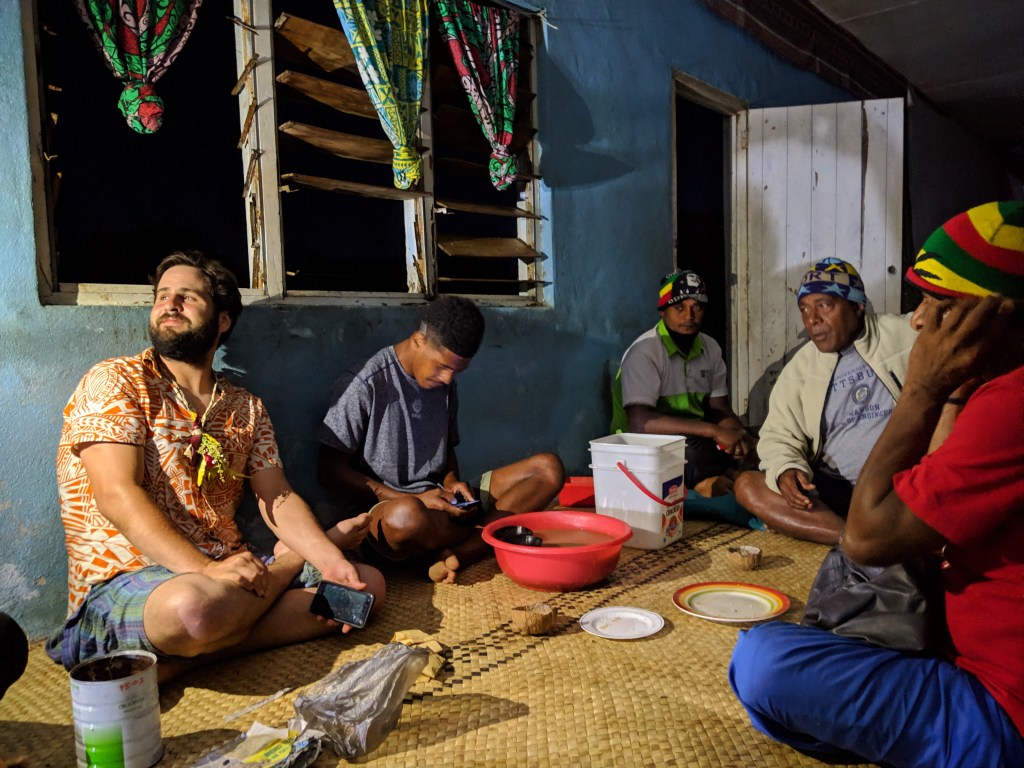
I also need to mention Mama. She was the caretaker of Rasalala where I stayed and cooked for us at least twice a day plus doing our laundry. She was phenomenal, hilarious and always made far more food than I could eat. The only dinner she didn’t cook was when Kristine and I tried to play Roti with Pratik playing Gordan Ramsey. Mama also has three kids and they study engineering, finance and cooking respectively. Classic examples of the new more cosmopolitan mindset of the younger generation. The oldest son studying engineering had to drop out though due to lack of funds. To acquire those funds, he was farming weed in Loa and showed up a lot. The second Saturday Brad and I were driving to the beach to relax when we found him on the side of the road, and he invited us to watch the rugby match against Canada with all the Loa boys (plus beer). While that would’ve absolutely been a thrilling time, Brad and I at that point just wanted to sit on the beach for a bit and relax. We aren’t Fijian.
We had a single day left after the completion of the pipeline which gave us time to meet with the water committees of Vunikura and Buca. Groups of half a dozen to a dozen individuals who oversee the water filtration systems of their villages when we’re gone and take care of all the repairs. The reason was we wanted to discuss them graduating of a sort because we had been in Fiji for ten years at this point and the ultimate goal of EWB with all communities we help has them being self-sufficient at the end. Therefore, we sat down the communities and bluntly told them our vision and how in 2-3 years we won’t be coming back. We did expect pushback because we contribute significant amounts of capital to the villages every year in projects but truthfully, they all understand. Which was uplifting considering that they thought themselves ready to take control and understood the technical aspects of building filters. Not to mention the ability to support the projects financially.
With that note out of the way Kristine and I packed up and all of us headed to Savusavu for the return flight. We literally swapped with Emily when she landed, and the bittersweet moment was lost when a traveling couple asked for an interview with Brad and we could barely keep ourselves from laughing our ass off. Because truth be told we never considered what we did lifechanging. Sure we believe that we do a lot of good in the community and have helped prevent incredibly dangerous waterborne diseases, but we aren’t heroes. The villagers don’t need to be saved. And that mindset was one I’m very glad EWB had for the entire trip.
To finish out our trip I asked Kristine what she wanted to do with our layover to which the response was “lots of beers”.
I’ll drink to that.
Sam’s Sermon Scales:
West Oakland BART similarities? – 8/10. High because there wasn’t an orthodox public transportation system. Let me finish, please. There aren’t many vehicles in Buca Bay so hitchhiking was incredibly common. We alone must’ve given dozens of hitchhikers rides every week. At one point we picked up an entire rugby team and dropped them off at practice. It even worked in reverse when Pritha and I didn’t want to walk home I flagged the first truck I saw and we jumped into an empty school bus that dropped us off at Rasalala.
“I could make this better!” – 5/10. They had teatime every day but by far the highlight of tea time was the pyramid of pastries we were presented with, not the tea itself. On the coffee front, we brought instant coffee that we drank in the morning and before grog sessions. 10 pm coffee was justified to fight the sleepiness of coffee. Instant coffee at best will always be merely fine and we started eating coffee dry and then pouring water in to speed up the process. I got an iced mocha at the halfway mark in Savusavu and it was heavenly.
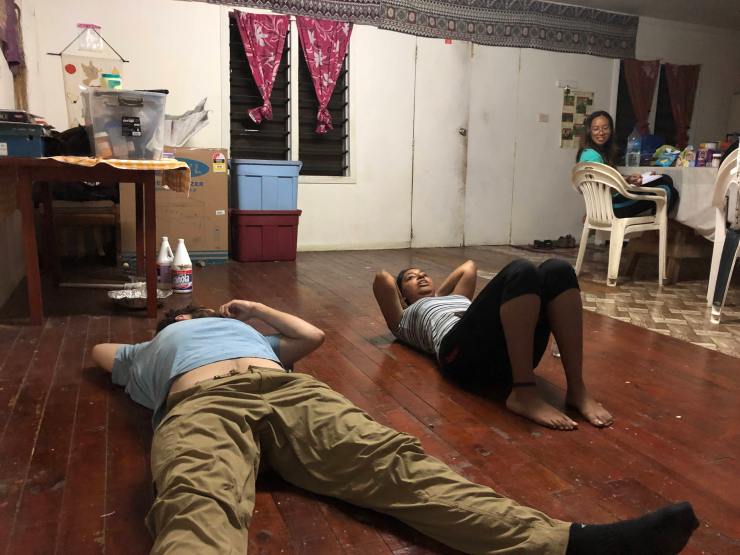
Folks of Culture? – 6/10. I got a rare look at working and living alongside a culture that pretty much independently developed for centuries. You learn that they say yes to nearly everything and don’t really have a sense of time management but overall great learning about something new. However, the very distinct gender segregation (with plenty of comments to Kristine and Pritha) plus the racism (to Pratik and Pritha) made the culture… a bit harsh. Pritha really did suffer badly.
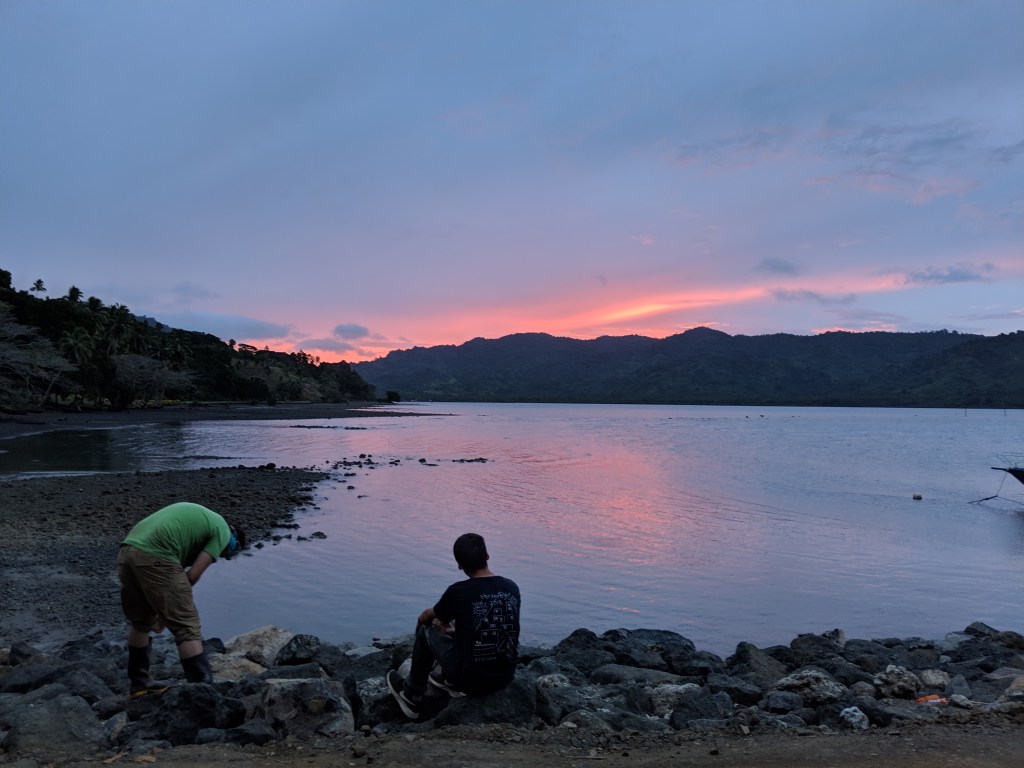
Golden Hour Opportunities? – 10/10. The irony of having the opportunity to do water engineering in Fiji was that you forgot sometimes that you were in Fiji. Between Pratik yelling “Sam you’re in Fiji!” or four of us yelling “Holy shit!” when we looked at the sunset right in front of us when we were at the mission doing extreme spreadsheeting and note-taking we occasionally remembered how amazing the country was to see. I don’t truly understand why people would vacation here, but I have a few theories.
Did the vegetarian starve? – 5/10. Everything tasted like coconut by the second week. Doesn’t mean that the woman didn’t try to accommodate me, lunch was just impossible. At home, I joke with my family that being a vegetarian will never be that hard because no one eats a main dish of meat with three sides of meat. Turns out Fiji does. Pretty much every lunch was Spinach, breadfruit, and coconut for flavoring. Woot Woot. Breakfast and dinner were better if a ton of carbs. Plus tea counted for a fourth meal of the day considering the number of calories consumed.
“Hey boss, can I work more hours?” – 3/10 or 9/10. Many of the resorts we passed on the road from town can easily put you back 15k dollars a week. Vacationing in Fiji for most tourists will be extortionary expensive not even to mention the flight tickets. Solid 3/10. However, I convinced Engineers Without Borders to cover 85% of my costs and fundraised the remainder so I personally paid absolutely nothing, but I feel for any poor souls that try and stay at a resort and want their kids to go to college so I got a 9/10 deal.
Cooler than Middle Earth? – 10/10. Pratik put it best when he explained the perk of doing this project to a villager in Buca Bay. “Sure compared to a normal vacation working on engineering projects is exhausting but it opens up a new avenue that you don’t get to see. The opportunity to casually drink tea inside one your houses or go spearfishing is a personal connection you can’t even get on a normal vacation.” So, for a new perspective and seeing a new part of the world, EWB was an amazing trip.
I went on this trip to learn more about if I was interested in developmental engineering and humanitarian aid projects. I learned that I absolutely want to look farther into this sort of engineering. A good feeling to know more about what you want to do for a living.
With my landing at SFO, I finished up 7 weeks of continuous travel this summer. I convinced organizations to cover $8,000, saved another $3,000 through crashing family friends houses, fundraised $2,000 and paid $1,500. Which I paid off working already.
One hell of a deal for seven weeks and I’m certainly not finished with EWB.
Photos credits go to Kristine, Pratik, Pritha and me.
Best,
Sam
 Dead Man Travelling